Locustdale is a coal company town located where Northumberland, Schuylkill, and Columbia Counties converge. It was home to the Locust Dale Colliery, later known as the Potts Colliery. George H. Potts, who operated other anthracite mines, opened the mine at Locustdale in 1853 (some sources say 1857). The earliest installation of a steam-driven ventilating fan, in the mid-1850s, was at this location. George Potts continued to be the operator until 1872. That year Philadelphia & Reading Coal and Iron Co. became the operators and would remain so until the end. The fact that part of Potts/Locustdale mine had been on fire for years did not deter P&R. A second slope portal was opened in 1874. Potts Colliery was a medium-sized producer until 1885, when the mine fires could no longer be ignored and the underground works were flooded. Potts was idled for the rest of the 1880s. In 1890 new pipes and pumps were installed down into the mines and dewatering began. A new breaker was constructed and production began to increase throughout the 1890s. By 1900 production was large. However, in 1910 Potts Colliery mines at Locustdale were again allowed to flood to extinguish once and for all the mine fires that had plagued the operation for years. The mine was once again dewatered by August 1911, the breaker was modernized, and other improvements were installed. Then production climbed until Potts was one of Philadelphia & Reading's best producing mines. After 1930, Potts coal was sent to nearby Locust Summit Central Breaker (see below) for cleaning and final shipment by rail. The 1930s and '40s were the golden age of Potts coal mining. Also, stripping started in the 1930s. Remining the Potts culm bank took place in the early 1940s. Potts production began to slow around 1950. It continued to decline until Potts closed in 1955, ending a century of underground coal mining at Locustdale. However, the renamed Reading Anthracite Co. continued stripping for a few more years.
March 2025 image by author
Locustdale, Pa. "patch" town.
Image source forgotten
Here is an artist's drawing of what the company town looked like in
the mid 1860s. The historic houses are shown in the photo above. The company store in the center of the picture survived as a mom and pop store into the mid-20th century and the structure itself survived into the late 20th century.
Post card found on eBay
A vintage view of Locustdale as seen from the Potts breaker.
Google Street View image
This stone house at the back of Locustdale is next to where the Potts Colliery was located and is probably one of the earliest company houses. It could date to the 1850s.
Locust Summit Breaker
In the late 1920s, Philadelphia & Reading Coal & Iron Co. made the momentous decision to centralize the processing and shipping of their many Western Middle Coalfield collieries at two modern central breakers. One was the St. Nicholas Breaker and the other was the Locust Summit Breaker near Locustdale. The Locust Summit Breaker received by rail coal mined at Potts, Reliance, Locust Gap, and Alaska Collieries. It opened in 1930 and featured the latest coal cleaning technology such as Chance sand cones. Coal coming to Locust Summit Breaker from the surrounding mines was received through a double rotary gondola car dumper. There was also a mine at the site of the breaker known as Locust Spring.
1990s Historic American Engineering Record, Creator, et al., photographers by Parrish, Wanda, et al.
The motor barn is still being used by a coal company as a repair shop in the 21st century.1990s Historic American Engineering Record, Creator, et al., photographers by Parrish, Wanda, et al.
The double turnover rail car dumper that received the incoming coal at the Locust Summit Breaker.1957 image by Robert Wanner
The Locust Summit Breaker closed in the mid 1950s. This photo shows it just after being idled. In the foreground is an electric locomotive used to move rail cars full of coal around the large rail yard associated with the breaker.
March 2025 image by author
Looking out over the former Locust Summit Breaker location. It was demolished in 2002. Reading Anthracite, a direct descendant of Philadelphia & Reading Coal & Iron Co., is mining and remining and re-remining the area.
March 2025 image by author
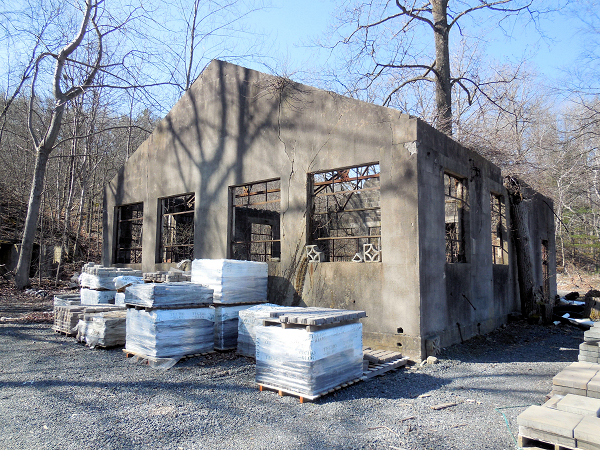
Vestiges of the Locust Summit Breaker operation: The building on the left was the boiler house for the thaw shed. On the right may be a remnant of the thawing shed where railroad cars of frozen coal were warmed in winter before being dumped at the rotary dumperMarch 2026 image by author
Remains of the lamp house that was at the No. 2 Summit Slope of the Locust Spring Colliery. This was practically right across the railroad tracks from the Locust Summit Breaker.