

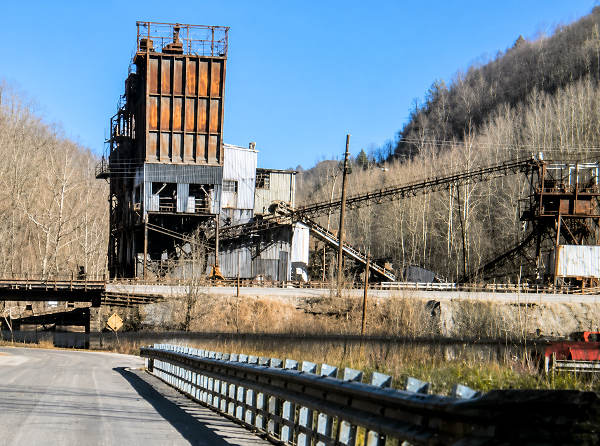


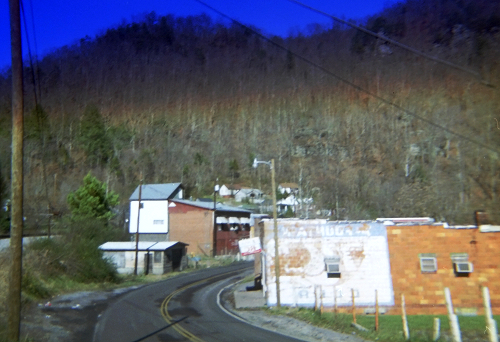
"The landscape record of mining infrastructure is expressed subtly by numerous relict features. Sealed mine entrances, like the entry opened at Deerfield in 1945, make a tacit statement from the past. At Maybeury, only the concrete piers of the railroad trestle remain, standing as stark monuments to a past era of economic activity. Across the region, stoneworks of foundations and retaining walls crafted by immigrant Italian masons exist as ubiquitous markers indentifying abandoned mine entries and tramways. Sue Newton, a Keystone resident, observed that today people look unkindly on McDowell County and its hard times and forget that for a long time it brought a lot of money and jobs to West Virginia. It also is easy to forget the area's lengthy contribution to national industrial expansion." From A Southern West Virginia Mining Community Revisited by Tyrel G. Moore. (Southeastern Geographer, 1998)
Memories of Elkridge and Northfork
Becky Lusk Hendrick grew up in the Elkridge neighborhood of Northfork. We are fortunate that she has shared some of her memories of growing up there:
Most of my family came from Wyoming County. My mom's family came from Grayson County, Va. When I was first born, we lived in Crumpler, which is at the end of Northfork Hollow. Then we lived in Keystone for a while, along the railroad yard in a railroad house. And then we moved to Elkridge, which is just as you start up Northfork Hollow. I had a great grandfather that worked for United Pocahontas Coal Co. in Crumpler, a great grandfather that worked in United Pocahontas at Algoma. My dad worked at Algoma, and my grandfathers worked, one at Crumpler and one at Algoma. At the company store in Algoma, you could buy anything there. They had clothes. They had household appliances. They had groceries. Just anything you could think of. They had a butcher shop. By that point we didn't have scrip, so they put the cost on our credit account. They put it on your family's account and then they would just take it out of my dad's paycheck. My father died of black lung. He died of pulmonary fibrosis, which is what you get from black lung. But my dad loved mining. He loved working for that company. He didn't know anything different. For three generations he worked there. We moved to Elkridge when I was six, and I lived there until I graduated and got married. In our neighborhood, because our basketball team won eight straight championships in basketball, there was a basketball hoop everywhere. So, we played a lot of basketball. We played kick the can. We rode our bikes up and down the alleys. We learned a lot from the immigrant families. I feel like we were a melting pot of all nationalities, and we learned a lot from those people. And the sad thing for me is, that as they married out of their culture, some of those traditions have gotten lost. And I always admired the different cultures. All of our neighbors were Italian. My mother was really good. She didn't graduate from college, but she did work at the bank in the bookkeeping department. She would help balance their checkbooks, and she did their taxes for them, and she didn't charge them any money for that. In turn, they would make a lot of good food for us. I have one little story that's my last memory of being in Elkridge. Whenever I was growing up, if your shoes needed repair, a lot of Italian people came to this country, and they repaired shoes. Mr. Areno repaired our shoes many times growing up. He had a shoe shop in Northfork. As people stopped getting many repairs on their shoes, he moved his equipment to the back of H&M Shoes in Bluefield. But he still lived there in Elkridge. When his wife passed away, he didn't have anybody there to take care of his daughter. So, he moved all of the equipment back into the basement of his house. And I was getting ready to visit my grandmother in Bluefield, and my mother-in-law had a pair of shoes that she needed some repairs done to. And she asked me if I would drop them off with Mr. Areno whenever I was on my way to Bluefield, and to tell him that she would pick them up the next time she came through. Well, when I knocked on the door with my two small children, he had us come in. I realized that it was not going to be a drop off and then leave. He wanted some company. So, he called upstairs and had his daughter bring down some pizzelles, because his wife would always make those. By this time , maybe he or his daughter made them. He gave my kids pizzelles, and he gave me one, of course. He started sewing the shoes, and I said, "My mother-in-law's going to pick these up." And he said, "No, no, no, you're going to wait for them." So, he finished them, and then he wouldn't let me pay him. And I can remember him saying, which was so much like I remembered from the Italians - I said, "Mr. Areno I hate not to pay you." He said, "You're not supposed to hate it. You're supposed to love it." When I graduated from high school in 1975, we still had all of our neighbors with what we would call "broken English." But I could understand them because I had been around them all of my life.